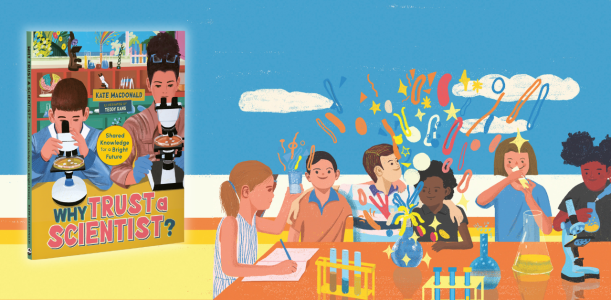
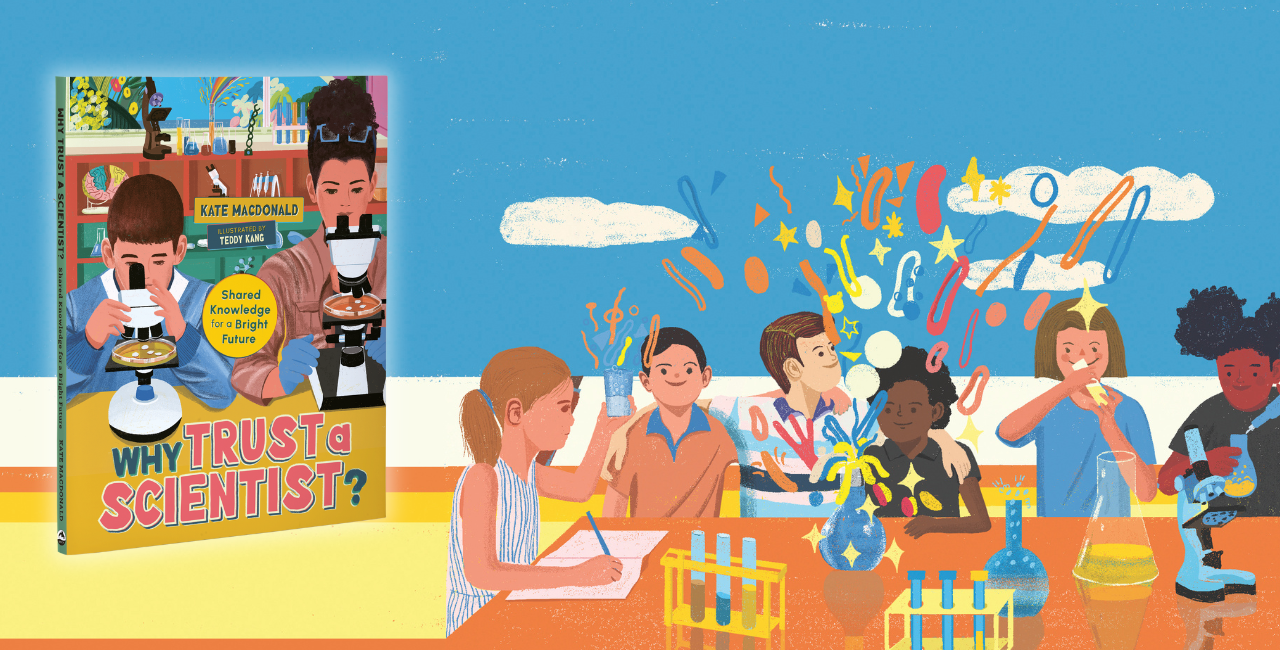
Why Trust a Scientist: Shared Knowledge for a Bright Future examines how and why trust in science benefits all of society, and answers questions about the scientific revolution, the scientific method, how scientists work together and what scientists do. Read on to hear from author and cell biologist Kate MacDonald about what inspired her to write the book.
What inspired you to write Why Trust a Scientist?
It was the COVID pandemic of the early 2020s, while I was watching a severe miscommunication between scientists and the public play out in real time. I’m a cell biologist, not a medical doctor or a public-health expert, so I wasn’t directly involved in COVID research or the pandemic response. But I was extremely familiar with the kinds of studies being cited by those experts as they communicated our vaccine timelines and our masking mandates. When the message “Don’t buy a mask, the virus spreads through heavy, wet droplets, not aerosols. You can’t inhale it and masks will do nothing,” became, with equal confidence, “Definitely wear a mask anytime you’re around people; you will inhale the virus and be an asymptomatic carrier for days, spreading it to everyone you meet,” I was not surprised or disturbed. Scientific consensus changes all the time, in real time, as researchers around the world do more experiments and realize that there’s a better way to interpret our data.
Large swaths of the public, however, were extremely disturbed by these reversals of opinion, and they felt they’d been somehow duped. They were under the impression that scientific facts are immutable, bedrock truths about our world, so this reversal might indicate a cover-up or a huge mistake by somebody who should be fired. But scientific facts are not immutable truths. They are, fundamentally, stories that scientists tell about the world. Those stories are based on the observations we make in the lab, and they’re subject to the logic-rules imposed by the scientific method. Historically, this approach to fact-finding has worked extremely well, and we’ve learned things about the universe that have allowed us to build planes and transistors and vaccines that save lives. Importantly, though, despite being probably-true stories, scientific facts are still stories. Stories can change with new characters and new information. As the pandemic continued, I realized that a lot of people did not understand the extremely human, storytelling practice that underpins the discovery of scientific facts. They didn’t understand why the consensus kept changing, or why they should believe anything a scientist said. I hoped that by writing this book I could show readers why this humanistic, collaborative process works so well to teach us about the world, and why the facts we learn are worthy of trust.
Have you always been interested in science? Why did you decide to become a cell biologist?
I have not always been interested in science! I wasn’t the kid who was playing with toy microscopes or begging to go to the planetarium every week. I thought “being a scientist” meant doing tons of math and spending hours building fancy gadgets in a lab, and that didn’t really appeal to me. What I really loved was reading and writing. I consumed more books than anyone I knew, and I’ve been writing stories for as long as I can remember. But I was also an extremely good student across the board, and my science scores prompted the adults in my life to encourage me to head for medical school. When I got to college I started volunteering in a biology lab on campus, because that’s one of the things you do when you’re planning to apply to medical school. That lab job completely changed my life. I realized that professional science wasn’t math and jargon and high-tech gadgets—it was reading and writing! It was going for a walk around campus, imagining how our cells might be working and creatively coming up with the experiments that will tell you if you’re right. It was immersing yourself in nature, trying to figure out the rules of this planet we share. It was using your own two hands to keep a Petri dish of human cells alive long enough to ask and answer your question. I knew I wanted to do this forever and that professional science was the path for me.
What does an average day as a cell biologist look like for you?
The first thing I do when I arrive at the lab is check on my cells. I grow plates of human cells in an incubator that keeps them warm and pumps in air with the right oxygen/carbon dioxide balance to make them think they’re happily living in a body. I make sure they’re still alive, and then I start my experiments for the day. I study how cells respond to DNA damage, so my experiments generally involve stressing the cells out and trying to figure out every step of their response. I might use gene editing to knock out a single protein in my cells, and if they can no longer handle the DNA damage I throw their way, then I know that protein was essential for their stress response. DNA damage can be seen using a microscope and a few other molecular tools, so I can count how many broken DNA strands my cells leave unrepaired when my tested protein is missing. I’ll take photographs of the cells failing to respond to that damage, so everyone else can see what I’m seeing. After a few hours at the microscope, I’ll plot those broken-DNA counts on a graph, so I can be sure there’s really a difference when the cell has lost its protein, and I wasn’t just fooling myself. With those photographs and hard numbers in hand, I’ll head to a lab meeting, where all the scientists on my research team get together to share our data and talk about the facts we might be starting to uncover. We’re all there to help and to course-correct, spotting errors in one another’s experiments or suggesting better ways to interpret our results. This kind of group-check is happening in every lab in the world, and it means that a fact has been deemed probably-true by teams of scientists before it ever makes its way to you. Eventually we will write up our new facts as scientific papers that anyone can read and learn what we have learned about human cells in the laboratory. Then I’ll head back to my desk, plan out tomorrow’s experiments, say goodbye to my cells and head home. If you want to see all of this for yourself, you can find my day-in-the-life videos on TikTok (@katemacdonaldphd).
Do you have a favorite fact or scientific anecdote that you learned while writing the book?
In the 1950s, when researchers were first trying to figure out whether human activities were causing our climate to change, one of the first pieces of data involved a volcano. Scientists realized that CO2 levels in our atmosphere were high, and they reasoned that if that CO2 was coming from our burning of fossil fuels, then as burning increased, CO2 should also increase. A chemist named Charles David Keeling set up a weather detector on top of the Mauna Loa volcano in Hawai‘i, and he measured atmospheric CO2 levels four times a day for almost two years. Just as the climate scientists had predicted, CO2 levels in the air rose and fell right alongside our levels of fossil fuel burning on the ground. I loved learning that story, because it really illustrated how far a scientist will go to collect the data they need. If they need to get to the top of a volcano, so be it!
What is one common misconception you often hear about the scientific process, or about a scientific fact?
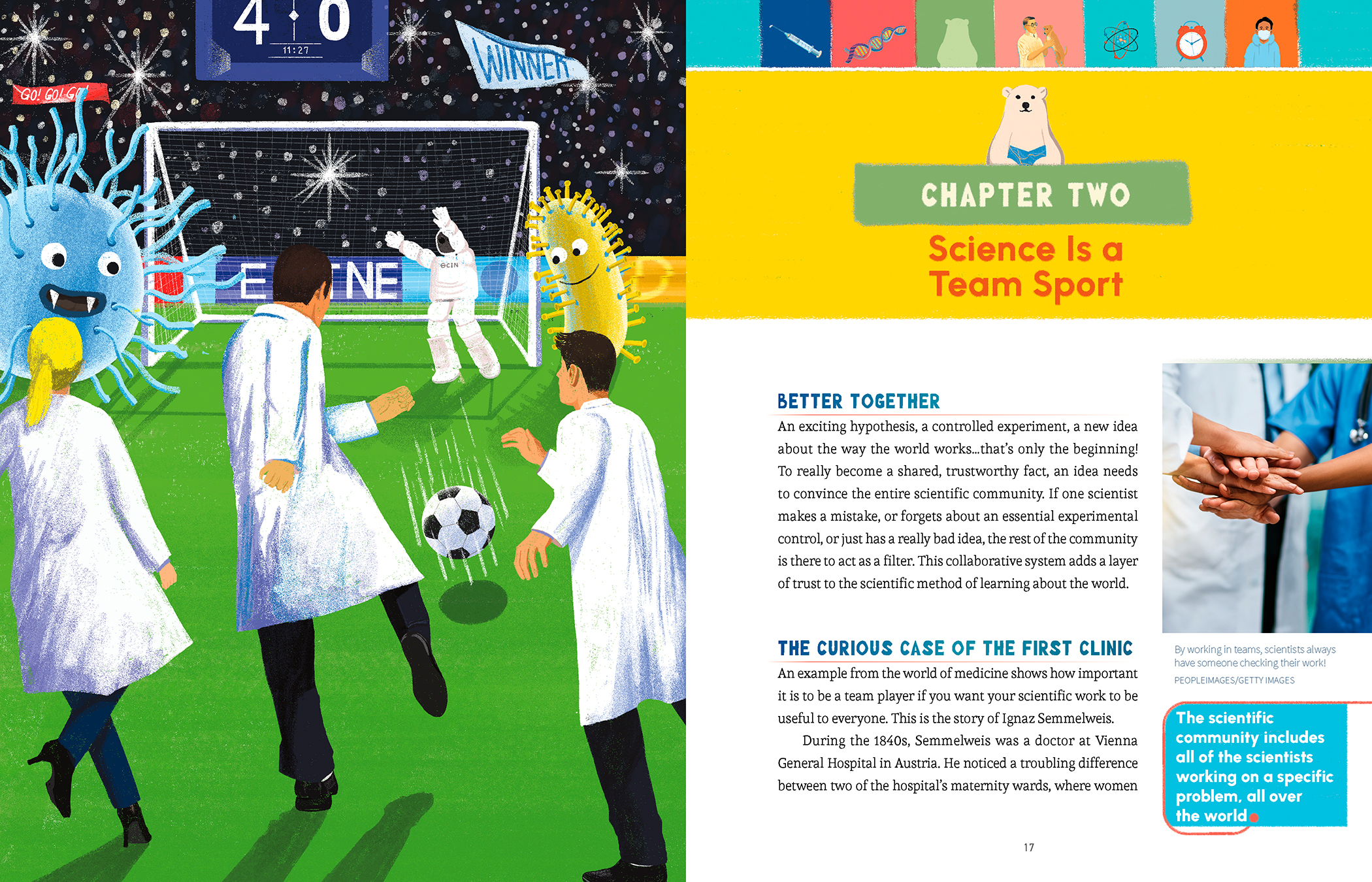
A big misconception is that scientific breakthroughs come from one genius’s flash of insight. In fact, science is a community-based process, so tons of people have to agree you’re right before a discovery really starts to take hold. That also means that truly earth-shattering, paradigm-shifting breakthroughs are extremely rare, because it takes so many years to convince enough people you’re right about a new discovery that many labs will end up contributing to the new finding. That’s something I tried to highlight in my book: that the scientific process is embedded in communities, not individuals. That should make it easier for scientific facts to be trusted, because while it’s easy for one person to be wrong in a moment, it’s much harder for hundreds of people to be wrong for years.
You founded a program called Zoom a Grad Student. Can you tell us a bit about the program and the goals you have with it?
I did! When I was in graduate school during the COVID pandemic, a lot of our in-person outreach programs were cancelled. Zoom a Grad Student (ZaGS) was a way to bring local high schools into our research communities, via the internet. ZaGS pairs high school classrooms in Toronto with two graduate students at the University of Toronto. The grad students speak to the high school students about their journey to professional science. This usually involves sharing their stories of choosing a college and a major, of deciding the profession they wanted to pursue, of letting go of failures and learning to define their life’s purpose. The broad goal of the program was to expose high school kids to the process of becoming a scientist. I definitely hoped this would encourage some future scientists, but if not, I hoped they could take the lessons we had learned from this collaborative, creative, community-based profession and apply it to whatever they chose to do with their own lives.
What is one thing you hope readers learn after reading your book?
I hope readers realize that science is deeply, fundamentally human. It’s a group project that we’ve been running for hundreds of years, as we talk and write and try to come up with a good explanation for how our universe really works. Those humans are central to the scientific process, because data does not speak for itself. We scientists speak for the data, we try to figure out what it’s saying to us about the world and we share what we have learned with everyone so we can all decide what to do next.
Is there anything else you’d like to add?
I hope that people know how seriously we scientists take our work. This work—to learn the rules of nature, to share that knowledge with everyone—is extremely privileged and extremely valuable. I do that work on behalf of everyone so we can all know more today than we did yesterday. I also genuinely believe that the scientific method is the best thing humans have ever invented. It’s fallible, for sure, but it’s the closest we’ve come to putting our human-brain biases aside and really getting to the truth about the universe. I trust that others are doing their own versions of serious, important work on behalf of others, and that together we are building a future that we’re all excited to enter.
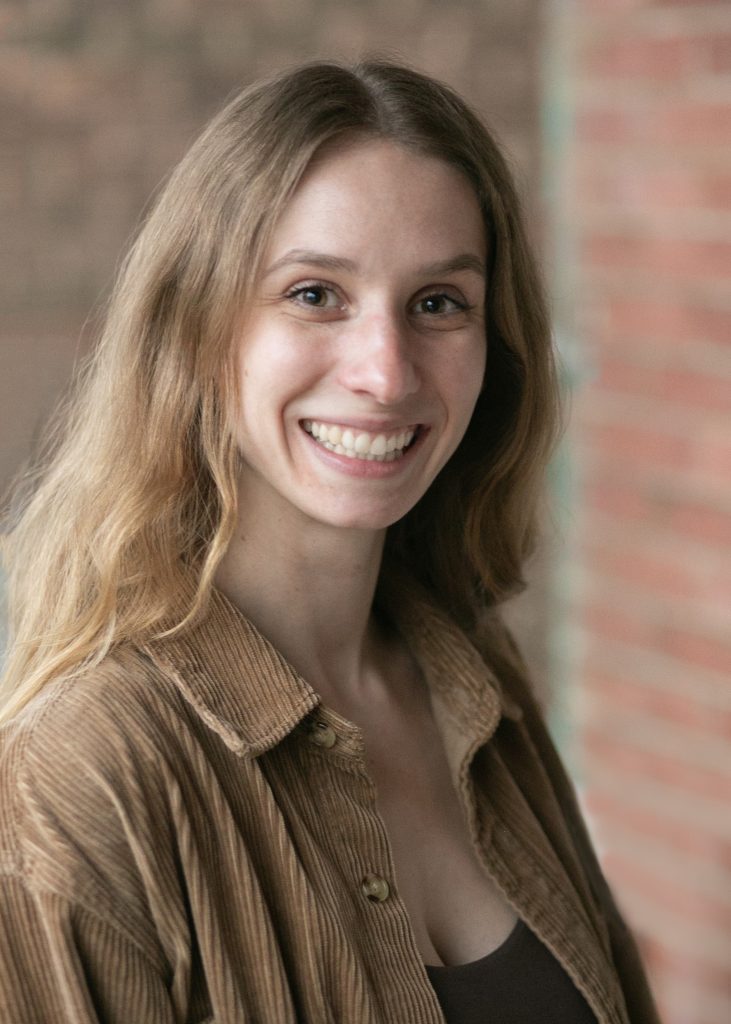
Kate MacDonald earned her PhD in medical biophysics from the University of Toronto, where she studied the cell biology of DNA damage. Her research has been published in top scientific journals, including Nature Communications and Molecular Cell. She is the founder of Zoom a Grad Student, an outreach program that connects high school students with scientists-in-training, to learn about STEM careers and navigating new-adult life. She currently works as a postdoctoral research fellow at Stanford University and lives in the Bay Area of California with her husband.