
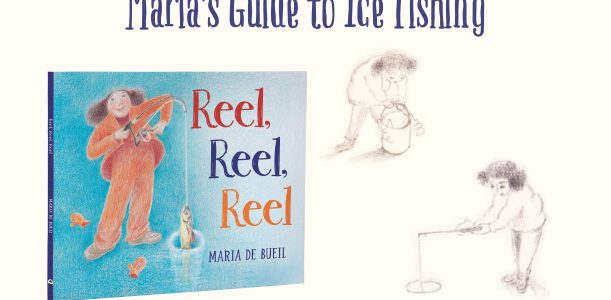
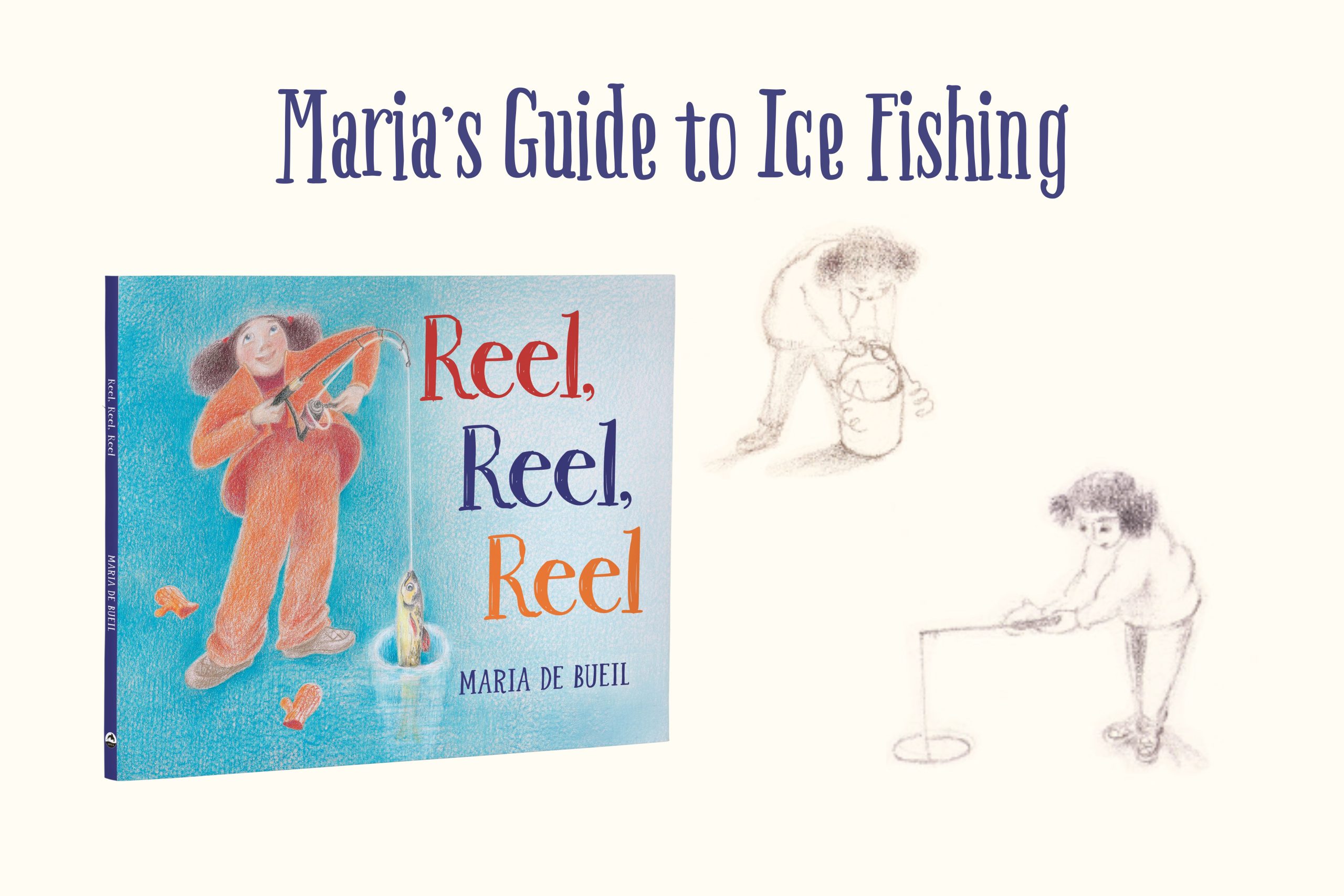
In Maria de Bueil’s upcoming picture book for kids, Reel, Reel, Reel, a girl and her father go ice fishing on a lake in the mountains. After a bit of waiting (and hot chocolate), they catch some spotted trout to bring home to their family for dinner.
Read on for Maria’s tips on how you can start ice fishing yourself!
Tip #1: Make friends that ice fish!
The best way to start ice fishing is to make friends that ice fish. You can also try talking to people at your local fishing store.
As for me, it was my husband that introduced me to it. I was hesitant at first, as I don’t really like the cold, but he assured me that I would appreciate the beauty of the nature and the luminous blue color of the ice inside the tent. He was right!
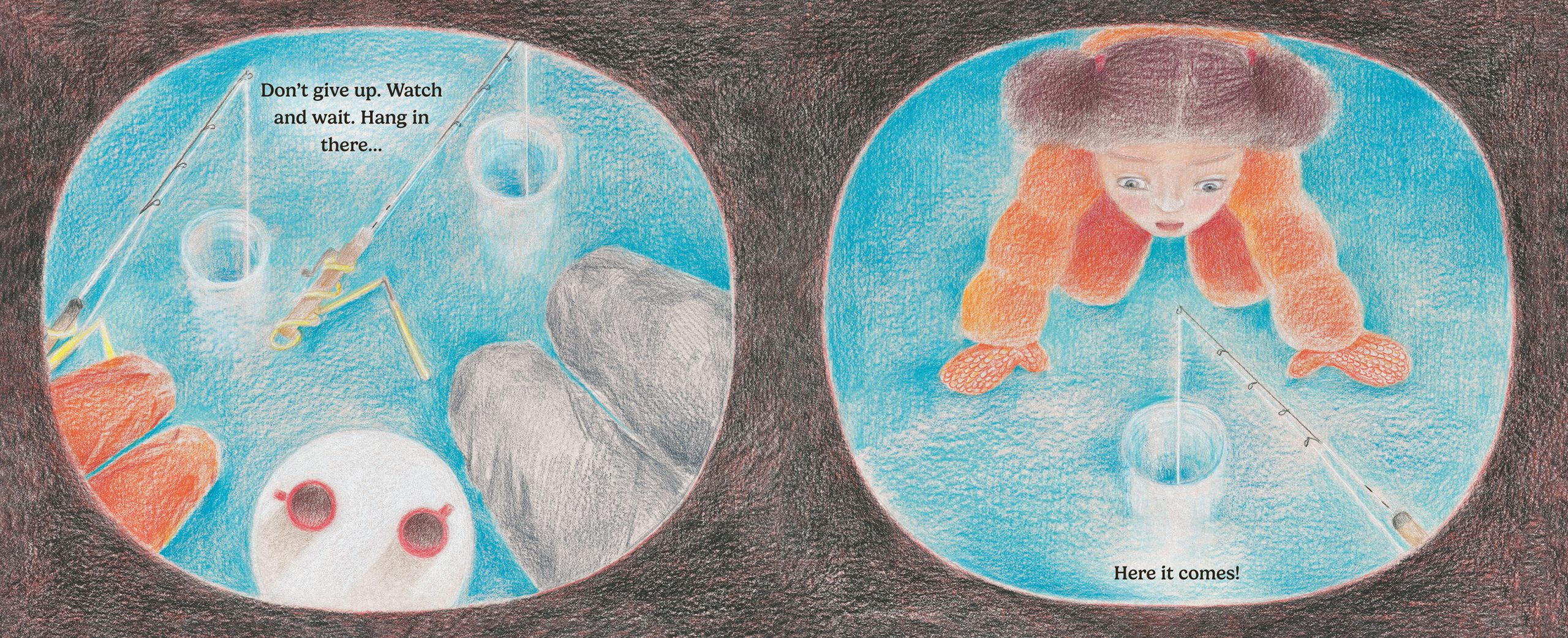
My first experience ice fishing was quite memorable. The ice inside the tent looked like it was lit from underneath the lake. This played a significant role in the inspiration for my book. Catching my first fish while packing up and reeling in the last rod was quite exciting too.
Tip #2: Pack your gear the night before.
Always pack your gear the night before. Kids can help! They usually love this part of the adventure—it helps build up the anticipation.
The best fishing is at dawn, so you need to be able to get up, drive to the lake, hike out with your gear and get set up by sunrise. You also might want to check what time your local doughnut shop opens and pick up provisions on the way out.
Tip #3: Bring ice cleats.
It’s important to bring ice cleats! When the ice is smooth and slippery, it can be very dangerous. A lot of ice fishing lakes are actually reservoirs, and their water levels decrease during the winter. This means that the ice in the middle of the lake, which is floating on the water, will drop in elevation, and the ice on the sides of the lake will crack and angle down to it. Kids will have fun sliding on the sloped ice, but walking down it can be hazardous.
Tip #4: Bring the right tools.
Use a manual auger to drill holes in the ice. You’ll also need a rod to fish with, a bucket to sit on and bit of patience.
If you want to take advantage of modern technology, bring a fish cam. A fish cam is a weighted camera that you can drop into a hole adjacent to the fishing holes, and it comes with a screen so you can watch fish approach your lures. I’m not sure it makes you a more effective fisher, but it is fascinating to watch fish investigate your bait.
Tip #5: Make it cozy.
If the fish are biting and you want to stay out for more than an hour or two, bring a few more supplies to make it extra comfy: a tent and a heater, and a stove and a kettle to make hot chocolate with. These are some of my family’s favorites! Grilled cheese sandwiches and corn chips are ice fishing staples, too, though nobody knows why.
Tip #6: Be patient and enjoy the experience!
You do need to be a bit lucky to catch fish, because sometimes they just aren’t biting. But what you’re really searching for when you go ice fishing is peace, not fish. That said, if you happen to catch one, it will be the tastiest fish you have ever eaten!

At the age of nineteen, Maria de Bueil was accepted to L’Ecole Nationale Supérieure des Beaux-Arts in Paris where she spent several years immersed in French culture. After graduating, she moved to Vancouver, where she was represented by the Simon Patrich Gallery. While reading to her children, Maria rediscovered the beauty of picture-book art. The idea of transferring her own craft into picture books inspired Maria to create her own stories and illustrations, with the hope of introducing children into the wonderful world of storytelling and fine art. Maria lives in Calgary with her husband and their four children, and divides her time between painting large canvases and creating picture books.