

★ This inviting offering features a unique emphasis on weighing the positive and negative aspects of AI.
Booklist, starred review
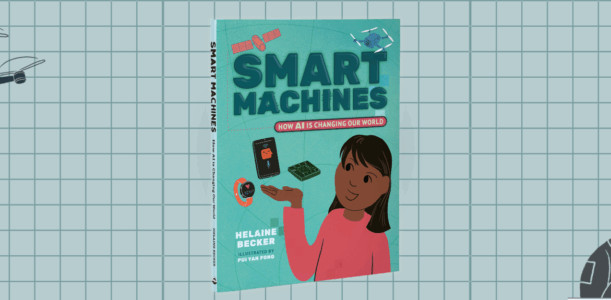
Helaine Becker’s new book Smart Machines: How AI is Changing Our World introduces young readers to artificial intelligence (AI) and how this technology will influence humanity now and in the future. Read on to learn about what inspired her to write the book and how she feels about AI.
What inspired you to write the book?
Generative AI only came into being in 2017. It’s still so new that no one who is not in IT—including me—knew very much about it. We certainly had no idea how it worked. I am a curious person and want to know absolutely everything, so it seemed like a great topic to research, both for my own benefit and for a possible book topic.
How much did you know about AI before writing the book?
Very little. I’ve written several tech-related books that cover aspects of AI (like Zoobots, and Hubots, which explore robotics). And as a longtime and award-winning science writer, I consider myself STEM-literate. But no one knew about generative AI apps like CHAT-GPT before 2017 because they simply didn’t exist. What I learned in my research was shocking. I’m still not over the sheer immorality of its promotors and its enormous potential for criminality and totalitarian control.
What was one fact that really surprised you when you researched AI?
That the folks who program generative AI apps don’t know—and can’t know—how the apps come up with their answers. They call it a “black box” because you can’t see what’s going on inside it.
What’s one thing everyone should know about AI?
That there are very many different types of AI. Some of them, like speeding up the process for finding and developing new compounds for medicine, are fantastic. Others are horrible and, quite frankly, bone-chilling in their possible scope.
What should we consider for the present and the near future with AI?
The most important thing is for ordinary people to disengage from social media, and other Internet tools that use AI in dangerous ways. I hope the younger generation will do just this. I also hope that responsible governments will put in laws that restrict their use of surveillance tech like smart city cameras and sensors.
What’s some technology that doesn’t exist yet that you hope exists in the future?
Tech that can limit and/or reverse problems of climate change.
What are some tips for researching online and assessing the credibility of a website?
There are quite a few things we, as internet users, can do to protect ourselves and our society from the biggest dangers of AI. The first and most important step is to use your brain. Does what you’re reading make sense? Who wrote it, and why? What does the website hope to achieve—to sell you something, or to promote a particular point of view?
What do you hope readers take away after reading Smart Machines?
That they can understand complicated topics and use what they learn to make the best possible choices for themselves and the planet. And that they will limit or even stop using social media.
Anything else you’d like to add?
I want adults to know that Smart Machines is not just for kids. It’s for grownups too, who never learned this stuff in school. And also that I’m looking forward to visiting as many schools as I can (I frequently tour in Canada and the US, and internationally) to share the information I’ve gathered with as many people as possible!

Helaine Becker is the award-winning author of more than 100 books for children, both nonfiction and fiction. She is the two-time winner of the Lane Anderson Award for science writing for children, as well as the Youth Book Award (Science Writers & Communicators of Canada (SWCC)) and the Libris Award for Picture Book of the Year Award (Canadian Booksellers Association). Two of her numerous math- and science-related books focus specifically on technology and robotics: Zoobots: Wild Robots Inspired by Real Animals and Hubots: Real-World Robots Inspired by Humans. Helaine’s books have been translated into 14 languages, and she is a frequent speaker at schools, universities and conferences.