
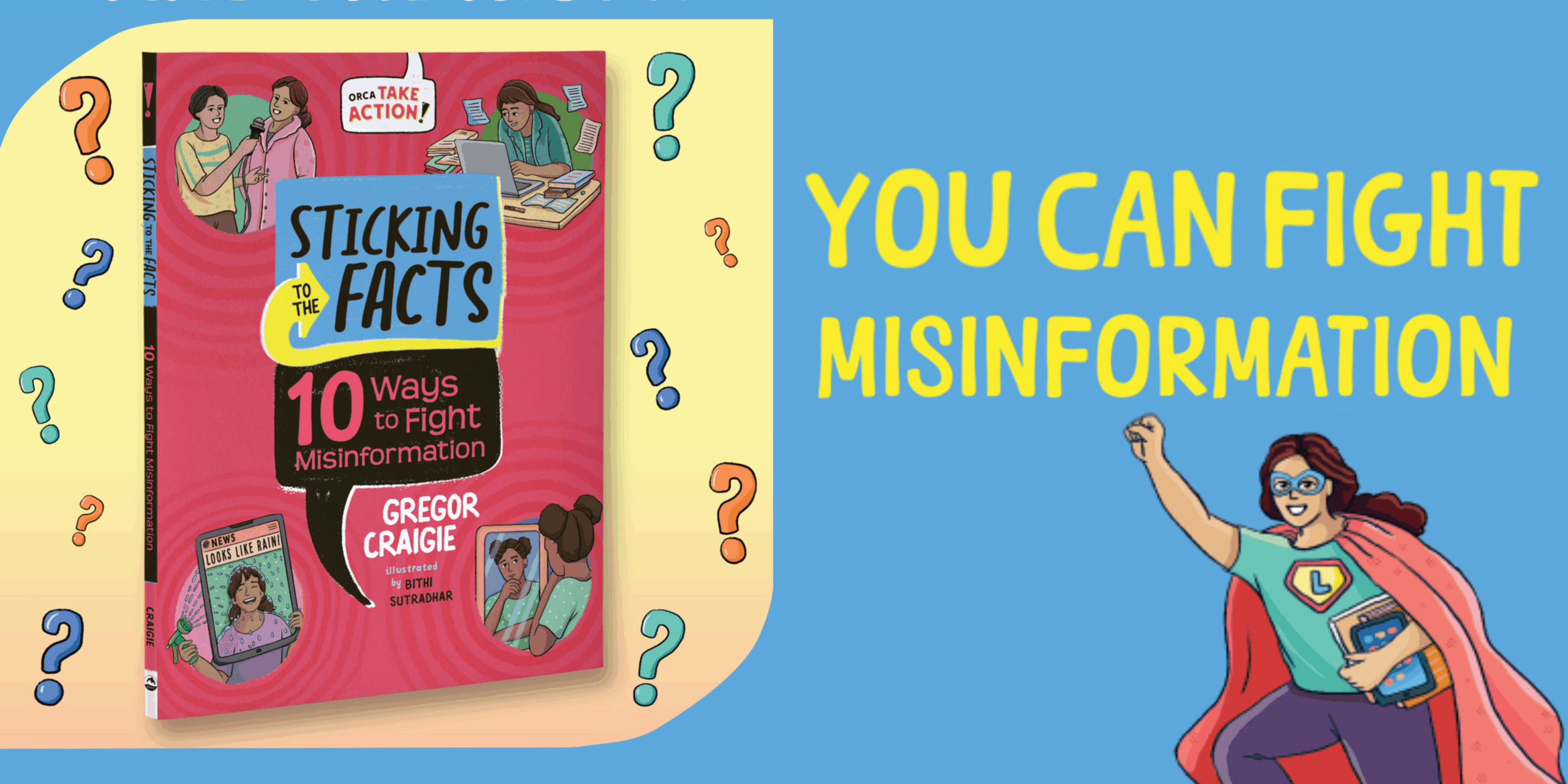
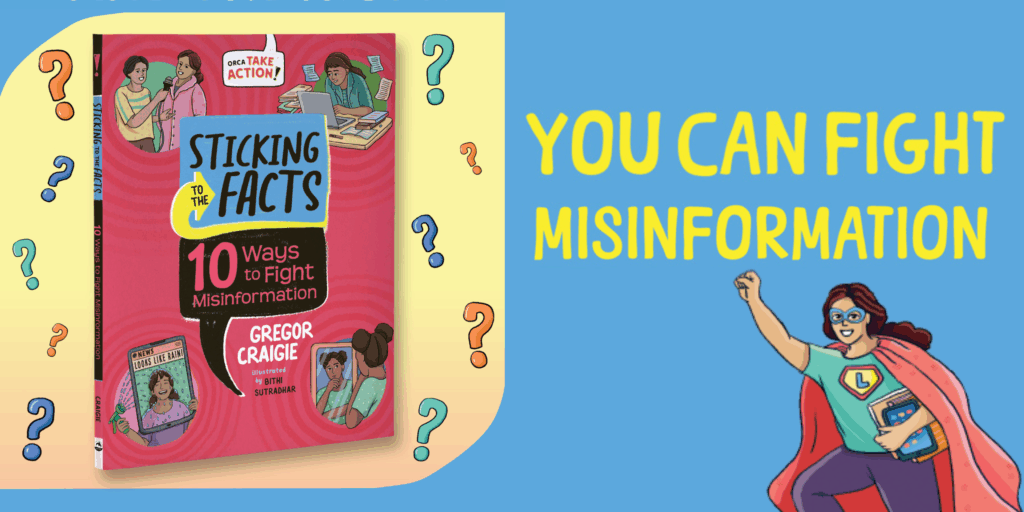
With information quickly available at our fingertips, it’s easier than ever to get caught up in fake news. In Sticking to the Facts, young readers discover tools to spot fake news and actions to take to fight misinformation and disinformation. Read on to hear from author Gregor Craigie and learn about the impact of the digital age on misinformation.
“When we become accustomed to reading news that is just plain wrong, it makes us wonder if anything we read is true.”
—Gregor Craigie, journalist and author
What were your initial thoughts when you were pitched to write this book for young readers?
I thought it was a great idea! Misinformation is such a big problem these days, and while it affects all ages, I think it’s especially important to teach young people what it is and how to spot it. They are growing up in a digital age where we have more information available to us than ever before, but more and more of that information is wrong, mistaken or misleading. Learning how to spot fake news is more important than ever!
Do you have any personal stories of misinformation from your years as a journalist?
I see misinformation almost every day that I go on social media. It’s sad but true that social media channels do little to check the facts of what most people post online, and as a result people post all kinds of falsehoods. Some are honest mistakes. Others are manipulations of the truth. And then there are the outright lies. Misinformation is rampant on social media, so it’s a big part of my job as a daily journalist to check if what I read is correct or not before I report on it.
How can fake news be dangerous?
Fake news can be dangerous in two big ways. The first is that it makes many people believe things that simply aren’t true. Imagine what might happen if a fake news story claimed the government would buy everybody a new house and give it to them for free, and that as a result of that fake news an elderly woman sold her house and spent the money from the house on a fancy new car and luxury holidays. She might have spent that money because she thought she didn’t need it anymore, only to end up with no money and no home. That may seem far-fetched, but real people make real choices based on misinformation, and they often suffer as a result. The second reason fake news is dangerous worries me even more! When we become accustomed to reading news that is just plain wrong, it makes us wonder if anything we read is true. Eventually, when people hear too much misinformation, they just stop believing everything, even things that are factually correct. Having a healthy community and healthy society relies on people trusting each other, but trust starts to disappear when we stop believing what other people say.
In the book, you talk about how misinformation is an old problem, dating as far back as the Roman Empire. Why do you think fake news is such a hot topic today?
I think it’s so important today because social media and smartphones are making fake news spread much faster than ever before. The old saying that “a lie can travel halfway around the world while the truth is still putting on its shoes” is more true now in our modern digital age than ever before.
What was one thing that surprised you when you were writing the book?
I was most surprised by your earlier point that misinformation has been around for thousands of years. It was used in the Roman Empire and in countless countries around the world over the centuries. That suggests to me that while social media and the internet have made misinformation worse, the problem itself is a very human one.
What do you hope young readers take away from Sticking to the Facts?
I hope they learn to be skeptical, not cynical. Someone who is skeptical looks at unknown things with an open mind, but they want to hear evidence and a convincing explanation before they accept that what they’ve just heard is true. On the other hand, someone who is cynical has decided they won’t believe anything, regardless of the evidence or arguments presented to them. Believing nothing is just as much of a problem as believing everything. In an information age where facts and lies are flying fast, it’s important that we know how to find out what’s true. I hope this book helps young readers do that.
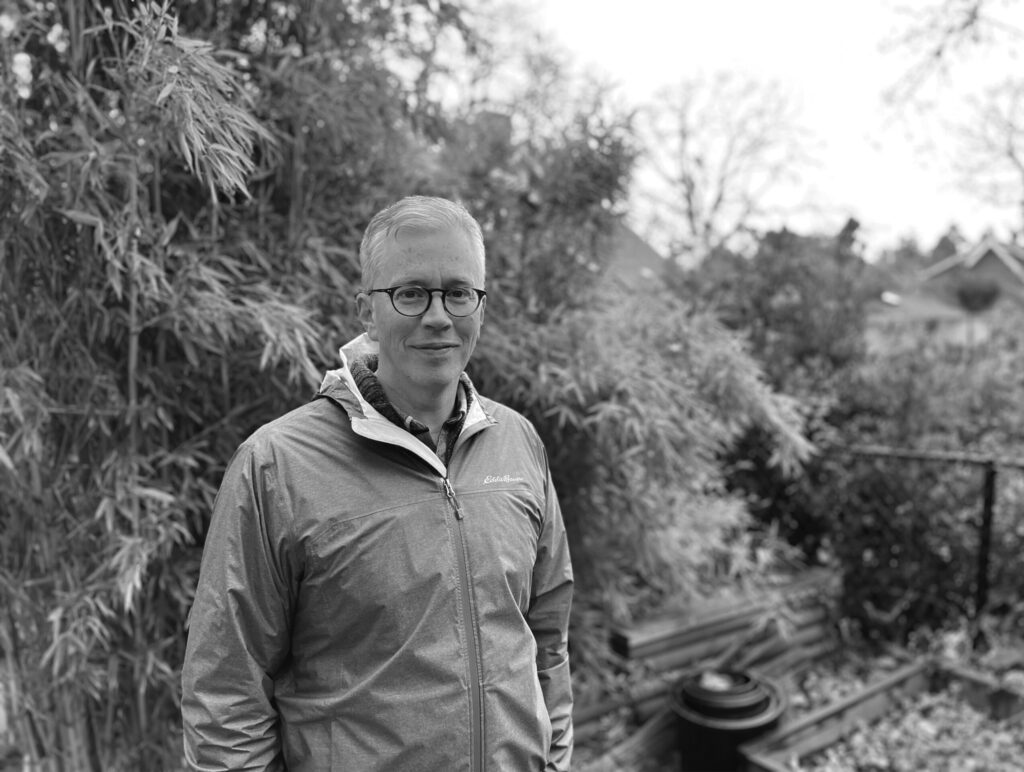
Gregor Craigie is a radio journalist and writer. He has worked for the Canadian Broadcasting Corporation for many years. Before that he worked in several cities, including London, England, where he was an announcer for the BBC World Service and a reporter for CBS Radio. Gregor’s first book for adults, On Borrowed Time: North America’s Next Big Quake, was a finalist for the Writers’ Trust Balsillie Prize for Public Policy and the City of Victoria Butler Book Prize. He is also the author of Why Humans Build Up: The Rise of Temples, Towers and Skyscrapers and Walls: The Long History of Human Barriers and Why We Build Them, both part of the Orca Timeline series, as well as Saving Wolfgang, his children’s fiction debut. Gregor lives in Victoria, British Columbia. Photo by Rebecca Craigie.