
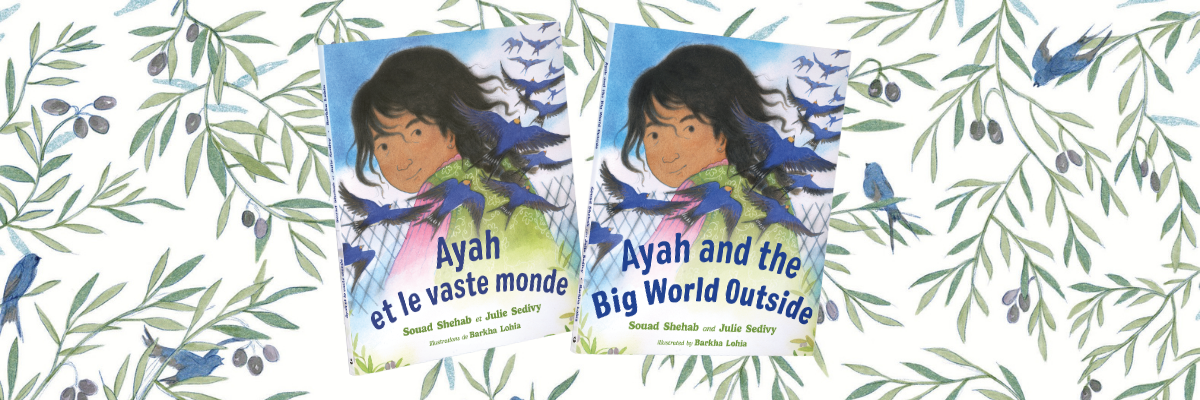
A unique and beautiful addition to picture book collections.
—School Library Journal
Authors Souad Shehab and Julie Sedivy met by chance and quickly became as close as sisters despite their different backgrounds and languages. In their moving new picture book, Ayah and the Big World Outside, young Ayah, who has always lived in a refugee camp, is trying to figure out what she wants to be when she grows up. Read on to hear from the authors about how their shared immigration experience shaped the creation of this story.
How did you meet each other?
We met in Toronto because of a real-life Ayah! Souad had traveled to Toronto to take part in a performance called The Shoe Project. Julie was there accompanying her young friend Ayah, who also took part in the performance. Both Souad and Ayah had lived in Syria when the civil war broke out. Julie and Souad discovered they were both writers and decided to meet again when they returned to Alberta. The main character in the book is named in honor of their mutual friend Ayah, who had, like Souad, spent some of her years in a refugee camp.
Both of you immigrated to Canada at different points in your life. How has that shared connection shaped your writing and your relationship?
Possibly the biggest thing we have in common is just our personalities! It’s amazing how similar we are. We both love to read and think, we’re both very curious about the world and art and other cultures, we both have a lot of internal energy and we laugh a lot together—Souad is one of the funniest people Julie has ever met. Our shared immigration experience certainly deepens the bond, although the adaptation process was different for each of us, having arrived at different ages. Souad had to reinvent herself in middle age. Julie was a young child when she came to Canada, but watching her parents gave her a sense of what it’s like to leave one’s homeland as an adult and make a new life for a family in the new country. It is nothing short of a heroic journey.
The immigration experience is central to our collaborative writing. Ayah and the Big World Outside is one of several stories we’ve written together. Some of them focus on life in the country of origin, and some of them focus on the adaption that children must go through when they arrive in a new home.
Where did the idea for Ayah and the Big World Outside come from?
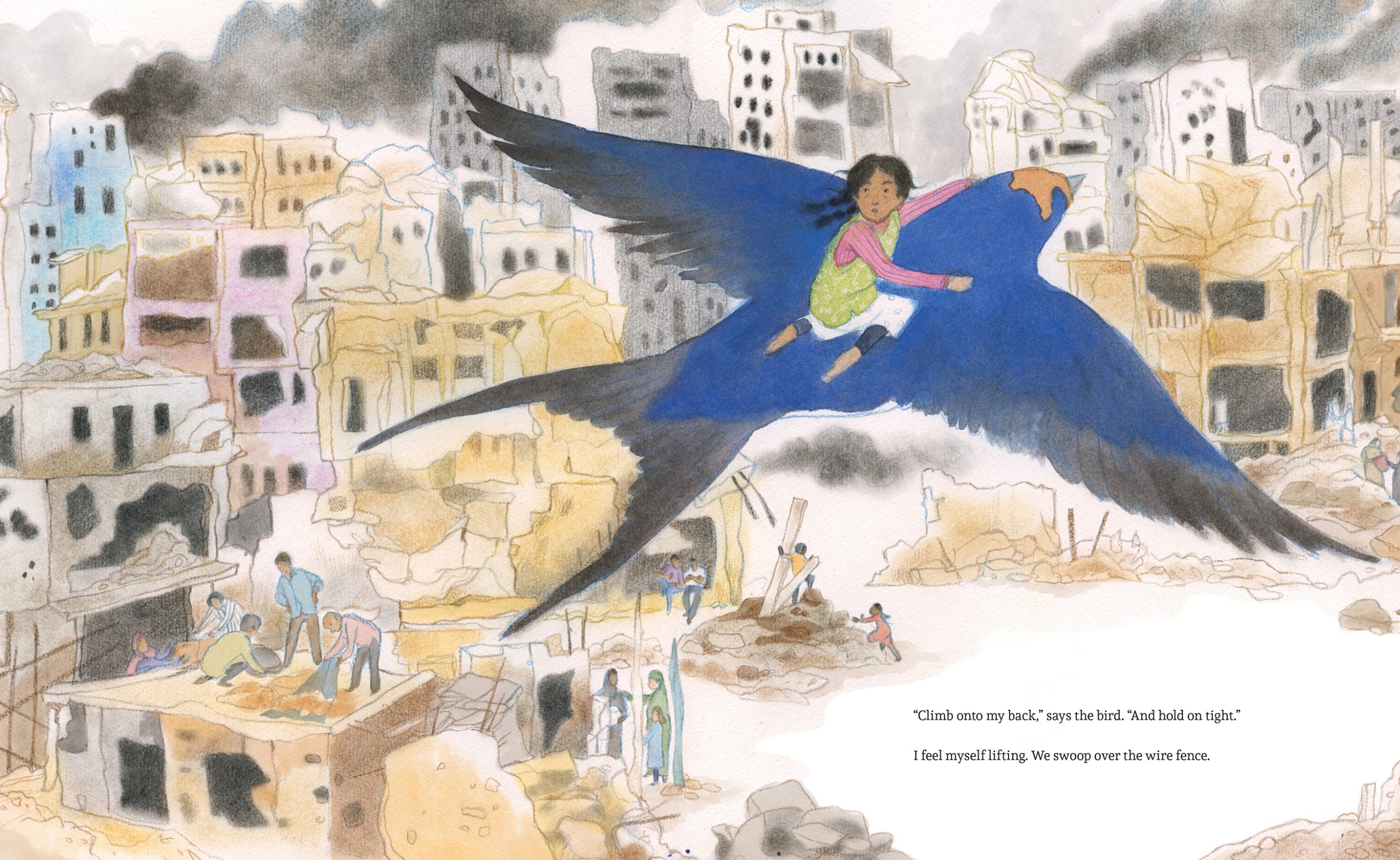
This idea drew heavily on Souad’s experience of life in a refugee camp. The story tries to capture some of the rhythms of daily life in a camp and how people try to keep dreams alive even though their lives are very confined. Julie did not experience anything like this directly, but she remembers hearing her parents talk about life as young people in Czechoslovakia. At the time, under the Communist regime, people were not free to travel outside of the country, and there were electrified fences separating their country from other European countries. She remembers her father talking about his dreams of escaping these confines, and this helped to shape some of the flavor of the text.
What did your collaborative writing process look like? Did you write together online, or did you get together in person to write?
A lot of the creative process took place over Zoom, and some of it took place independently and in separate languages. For Ayah, Souad generated a frame for the story in Arabic. Then we met over Zoom, and Julie wrote down a version in English, based on Souad’s relating of the story. Then we had discussions about how to shape the characters and the arc of the story, going back and forth over many drafts to try to capture the feel of the story and the relationship between Ayah and her mother. Writing a children’s book is a bit like writing a poem. You are working with a short text, so each word matters a great deal and has to do a lot of work.
Why did you choose a swallow to take Ayah on her journey?
This was drawn directly from Souad’s experience in the refugee camp where she grew up. She would watch the swallows as they arrived in the camp on their migratory route and would dream of being able to fly away like them. The swallow is also very symbolic of the immigrant experience, of feeling an attachment to two different “homes,” much as the swallow in the story has a winter home and a summer home. This is something we both feel very strongly.
What do you wish readers knew about the lives of children growing up in refugee camps?
That they need dreams and hope for the future, even if their circumstances make it difficult for them to imagine what that future could look like.
What do you hope readers take away after reading your book?
Unfortunately, the instability and conflicts around the world mean that people continue to be displaced from their homes, now and in the foreseeable future. We hope that this book will make these families visible to readers, as real, ordinary people who are trying to live their daily lives and who dream of a home where they can be free—or maybe more than one place they can think of as home.
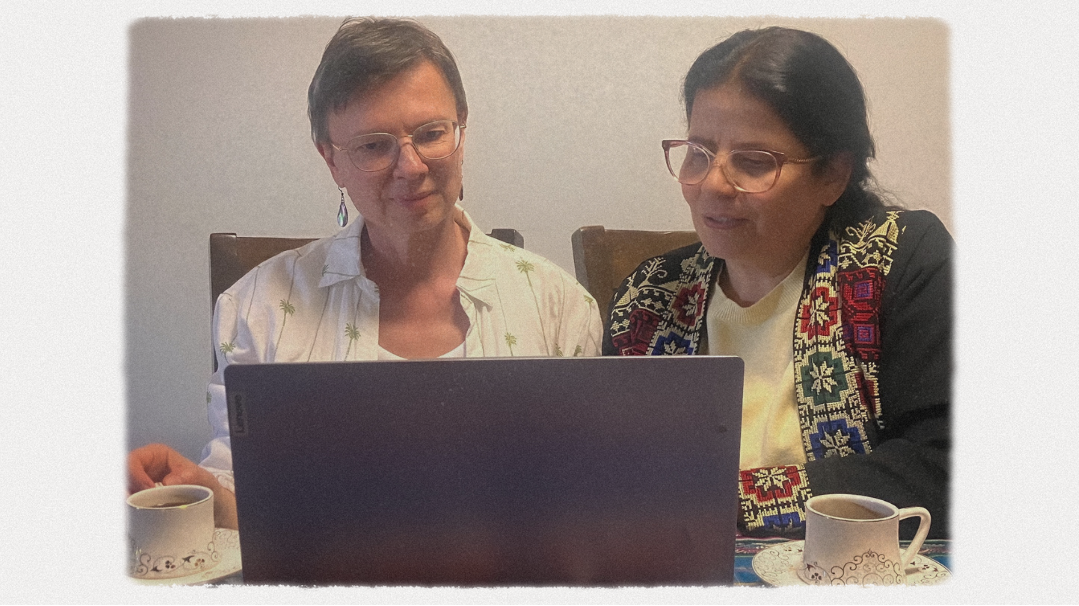
Souad Shehab (right) is a Palestinian writer who was born in a tent in a refugee camp in southwest Syria. She spent twenty-four years in the camp, where she experienced firsthand the difficulties of refugee life. Trained as a teacher, she taught in Syrian primary schools for twenty-five years and raised four of her own boys. She became a refugee a second time when civil war broke out in Syria, escaping to Lebanon and then arriving in Canada in 2017. She currently lives in Edmonton with her family, where she teaches preschool and is working toward her dream of establishing herself as a writer in her new home.
Julie Sedivy (left) is a citizen of three countries. At the age of two, she left the country of her birth (Czechoslovakia, now the Czech Republic) soon after the Soviet invasion of 1968. She has made her home in many places, including Montreal, upstate New York, Providence (Rhode Island) and Calgary, where she currently lives and writes. She has taught linguistics and psychology at Brown University and the University of Calgary and is the author of several nonfiction books, including Linguaphile: A Life of Language Love. She is especially interested in the complicated and beautiful lives of people who are not sure where to call home.