

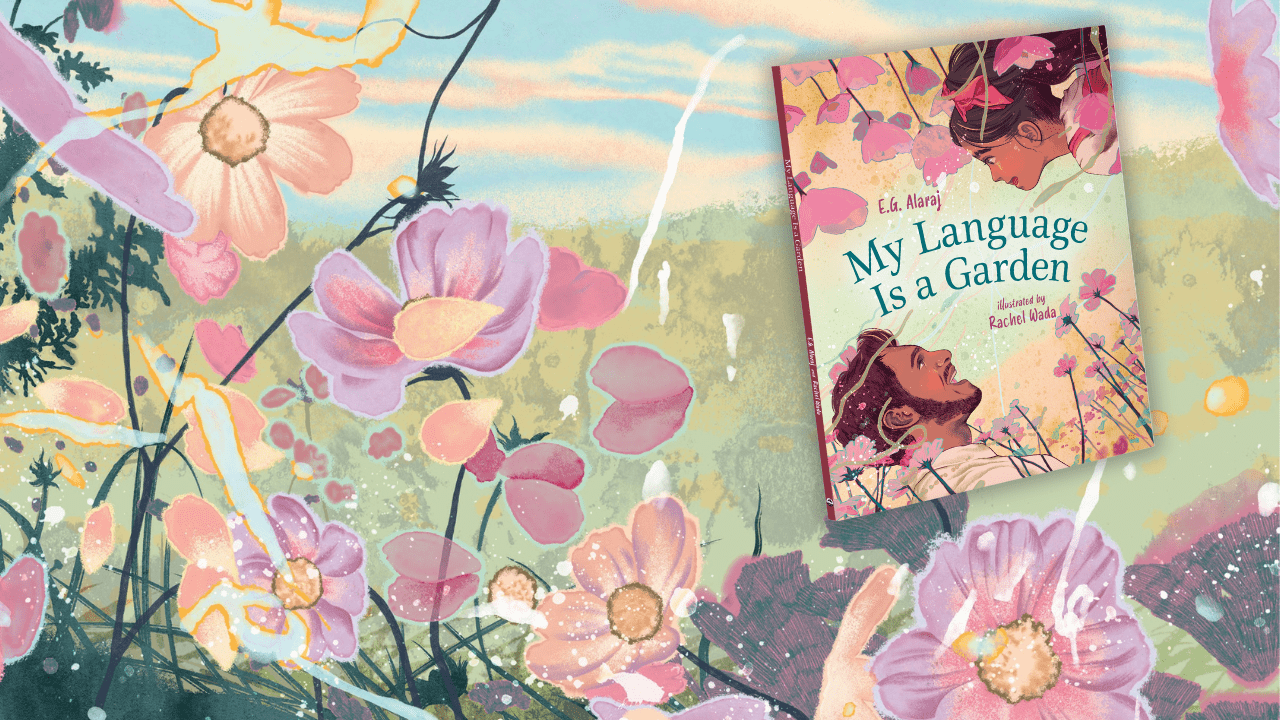
E.G. Alaraj’s beautiful picture book, My Language Is a Garden, is told in rhyming verse and follows a parent who tells their child about their heritage language and all that it represents, from ancient knowledge and medicines to exploration of the cosmos. By sharing this language, their hearts will be connected always. Read on to hear how E.G.’s family learning Arabic inspired her to write the book.
My Language Is a Garden is a beautiful poem that celebrates language and the bond formed between parents and children by passing down a language. How did your family’s experience with teaching/learning Arabic inspire this book?
It was difficult to build our children’s fluency in Arabic, which is their father’s native language. Like English, Arabic has been a global language for centuries and has grown to include many people, faiths and traditions.
I have to mention this because when we were a young family, there was—and unfortunately still is—a relentless global media campaign to vilify Arabic-speaking people, especially those of Muslim and Palestinian origin, casting them as subhuman or threats to the safety of humanity. As parents, our way of dealing with this hostility was to expose our children to the richness and significance of their language.
Doing so cost us time and money. We lost personal relationships, opportunities, energy and stability when we were already short of all these things, living in Vancouver with few family relations and the barest skills and resources from our own upbringings. However, the spiritual cost, the cost of our children growing up to believe deceptions about their Arab, Muslim and Palestinian roots, was in our eyes a much greater cost to pay.
Of course, the children were too young to understand our motivations until the calamities of the past few years. For the first time, they experienced the betrayal of their humanity by some friends, family members, teachers, school administrators and so on, but also much love and support from the courageous and outspoken. We are doing our best to keep them positively connected to their roots while processing an immense load of grief and loss.
What did your creative process look like while writing this poem? Did the words come to you all at once or in stages?
My first attempt at writing this story was not in the form of poetry. I tried to develop characters and a plot, using our family as inspiration. But from the initial draft, I could tell that the dialogue and events in the storyline would not be able to express everything I wanted to communicate on the topic of language. In addition to the family context, I wanted to connect the theme to global developments, such as the rapid decline and failure of human language systems around the world. So I put the writing aside, unsure of how I could develop these challenging themes in a way that would inspire children to value their cultures enough to hold on to them.
A few days later, the poem came on its own. I woke up at about 5:30 in the morning with a voice and rhythm sounding in my head. I wrote it all down, punching lines into the notebook on my phone because I had no pen or paper handy.
It was a shorter poem, so I originally submitted it to Orca as a board book. Then six months later, I looked at it again and felt it was missing some pieces of the human story, which is the story every language happens to tell. After adding another few stanzas and changing some words, I submitted the work again. So the poem mostly came all at once, except for a few minor revisions.
Learning a language can sometimes be a frustrating experience, but your poem conveys joy and positivity. Was it important for you to show that joy in the book?
Language learning is very frustrating. It’s exercise. You have to build muscles in your mouth to make the right sounds. You have to build your focus and attention to receive and communicate ideas, as well as your fine-motor skills to write by hand. Finally, you need speaking confidence. For a child growing up with multiple languages, this can feel like an unfair amount of work.
Then when you add faith and cultural traditions into the equation, some children and families can start to feel resentment for the amount of effort it takes to develop understanding. On top of all this, children are losing attention for human conversation when surrounded by communication technologies, which have their own built-in structures of language.
This influence of smart technologies on language acquisition in children is causing many families to feel despair and defeat. Teachers are also feeling these emotions, and we need to take this seriously and continue to motivate each other because language failures have catastrophic effects on human societies.
I wanted the poem to motivate learners and teachers beyond these slumps of frustration and despair, so a joyful, appreciative tone was essential for the poem.
How did you settle on the imagery of a language as a garden, and other living entities?
Languages have wonderful organic structures, with roots and branches that extend to the earliest days of human history. In addition, languages directly stem from biology. We are born making sounds and gestures to communicate our needs and connect to our environments, developing a sense of the world through patterns of sight and sound. We learn to read everything around us, the sigh of the wind, the fall of water, the cries of animals and other beings, before we learn to read words on a page; this literacy in being, in life, in interpreting sensory information, is integral to language development.
The connection between language and the natural world is not merely metaphorical. It is direct and essential to survival. Furthermore, our thoughts and behaviors are influenced by the material quality of the foods we eat and the environments we live in, so human knowledge depends on our relationship with nature. Industrial societies are very poor substitutes for the landscapes that have fed our mother tongues since antiquity.
The symbolic connection between words, ideas and landscapes are as old as time, but perhaps in our industrial societies, we now view these connections abstractly and dismissively as if we’ve grown out of them and have no more use for the natural world. I fear the form of knowledge we are building with this mindset.
What advice do you have for readers who are starting to learn a language?
Treat it like a sport. Learn the rules. Practice every day, or often, by speaking and listening with others, or practice on your own through reading and writing. Read a lot in the language you want to learn, starting with simple phrases, sentences and stories to build your vocabulary. Occasionally reward yourself with things that will improve your language skills, like good pencils, pens, diaries and stationery, or a brand-new book from a bookstore.
When I was little, I loved decorative pens. They seemed very special and interesting, and it still makes me very happy to purchase them, even happier than buying new books. A good writing instrument suggests that you develop your own voice rather than borrow someone else’s.
Do you have a favorite illustration in My Language Is a Garden?
All the illustrations are stunning, but my favorite is the final one, with the father and daughter looking up at the sky and chatting together. It takes my breath away every time. The colors are so beautiful and vibrant, and the spirit of the language seems to be stirring the landscape and sky like a wild wind. It’s gorgeous.
What do you hope readers take with them after reading your book?
I hope readers find the voice of the human spirit in my poem. If you listen closely to the rhythms and sounds, you will sense the human spirit moving about the poem. This spirit is yours. It belongs to all of us. Take it from these pages and plant it anywhere you like in the world.
Is there anything else you’d like to add?
For young or grown adults reading this, I’d like to mention a publishing initiative coming out of Gaza, called Coastal Lines Press: Zines from Gaza. It brings together young authors in Gaza and creative volunteers (me included) from all around the world. We produce booklets in multiple languages, which serve as material lifelines for the authors. The booklets are tiny vessels, guided by inner strength and courage, to the shores of other hearts. May the human story persist.
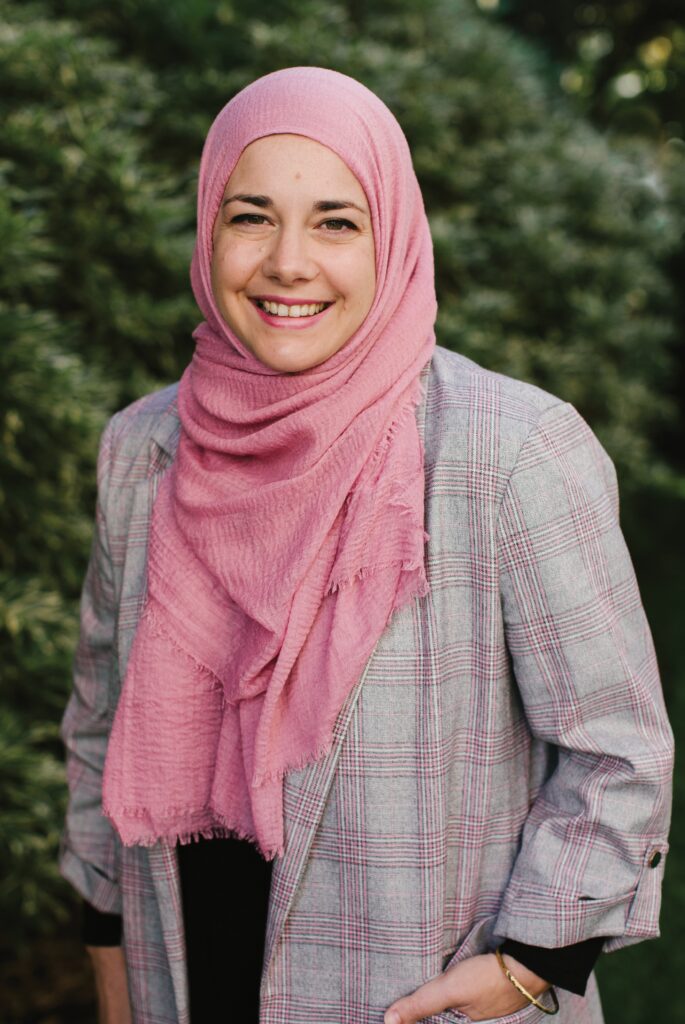
E.G. Alaraj grew up in the magical place that every child knows, where ideas look like pictures drawn from crayons, paint or ink and sound like stories from long ago and far away. The youngest of six girls in a homeschool family, she spent her childhood with her nose in storybooks, art books, music books, notebooks and trouble—especially trouble. In fact, she thinks trouble and imagination are best friends. E.G. lives in Vancouver, British Columbia.