
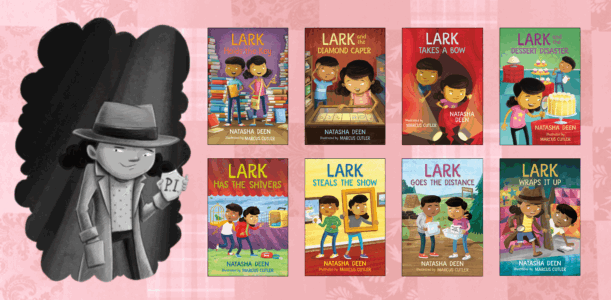

In Natasha Deen’s newest chapter book, Lark Wraps It Up, Lark and Connor learn their halmoni’s friend Miss June had her homemade quilt stolen from her backyard. They gather their friends in hopes they can sleuth out the culprit and find the quilt before the quilt show wraps up.
Read on for the inside story of how the author learned she is dyslexic, and why it’s important for readers to see dyslexic characters that are more than just a label.
A few years into my career as a writer, I was doing one of my favourite activities: visiting with a school and having a blast with the teachers and students. It’s always a lovely moment of connection for kids to have a multi-published writer acknowledge that writing can be a boring, frustrating slog of a thing. My “admission” gives them space to see the challenge but also the sense of victory and accomplishment in tackling something they find difficult. We laughed, shared stories, and “competed” to see who had the best “writing is the worst” story.
Afterward, the teacher, curious about some of the struggles I’d shared about my writing, asked if I would be up for answering some of the literacy assessment questions the school gives their students. When we’d finished the test, the teacher looked at me and said, “Natasha, has no one ever told you that you’re dyslexic?”
No, they hadn’t.
They’d told me I needed to work harder, to focus more, that if only I really tried, my marks would improve. They’d told me I was lazy, and my grade twelve math teacher—when I’d gone to him, desperate for help—had told me I was stupid.
Dyslexic.
For some people, maybe this was the worst thing to hear. For me, it was a relief. My struggles with school suddenly had a context. It was a bright moment of clarity, quickly followed by anxiety. What if the teacher was wrong? What if the teachers before him were right? Maybe I didn’t learn differently. Maybe I was just lazy and unfocused.
Later, when I related this experience to someone close to me, they said, “No, Natasha, that’s not true. The teacher was wrong. You’re normal.”
It was another moment of context and clarity, albeit not one that brought relief. I wondered about this idea of “normal” versus not. Years before my encounter with the teacher, I volunteered as a reading mentor for students whose literacy levels were below their grade. One day, a family came through on a tour. Their child, excited by the teacher and the activities in class, said, “Wow! I hope I end up in this class!” Horrified, the mother replied, “No! You don’t belong in this class. You’ll go to the regular class.”
Her words angered me—not just for her ignorant idea that literacy was the only marker in which to judge a child’s intelligence or worth, but also that she said it where the students could overhear.
This misconception that being neurodivergent is subnormal is one that continues to linger despite overwhelming evidence to the contrary. Yet when I think back to being in junior high and the hot-cold feeling of panic every time I stepped into class, the overwhelming sense of failure each time a test was put in front of me, and what I would have given to have someone tell me, “HERE is how your brain works and HERE is how we accommodate it—and by the way, YOU’RE PERFECTLY FINE AND NOT SUBNORMAL!” that would have meant the world. Not for the academic success, but for the relief it would have given me as a child. I wasn’t stupid. I wasn’t lazy or unfocused. I just came to learning differently. It would also have given me relief as an adult, because I’m still chased by the fear that the teacher was wrong and that, in the end, I just need to try harder.
Through the Lark Ba series, I want readers to see that just because someone’s brain processes differently, it doesn’t make them less-than. With Lark, readers can experience a character who is clever and funny, curious and engaged in the world, who is more than a label. I want readers to see that like Lark, their brains work in beautiful ways, they are more than the sum of their educational struggles, and to recognize their intrinsic value to themselves and the world around them.

Natasha Deen loves stories: exciting ones, scary ones and especially funny ones! As a kid of two countries (Guyana and Canada), she feels extra lucky because she gets a double dose of stories. Natasha is the author of many books including the Lark Ba Detective series in the Orca Echoes line, Depth of Field in the Orca Soundings line and In the Key of Nira Ghani which won the Amy Mathers Book Award and was nominated for the Red Maple, MYRCA and R. Ross Arnett Awards. She is also a recipient of the Queen Elizabeth II Platinum Jubilee medal. Natasha lives in Edmonton.