
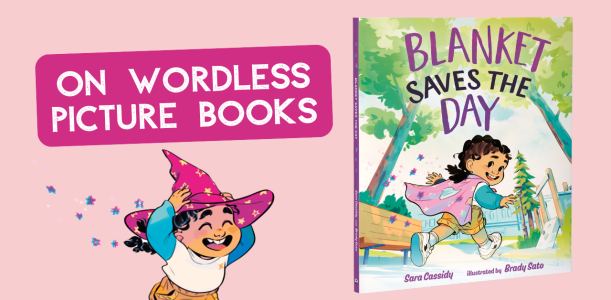
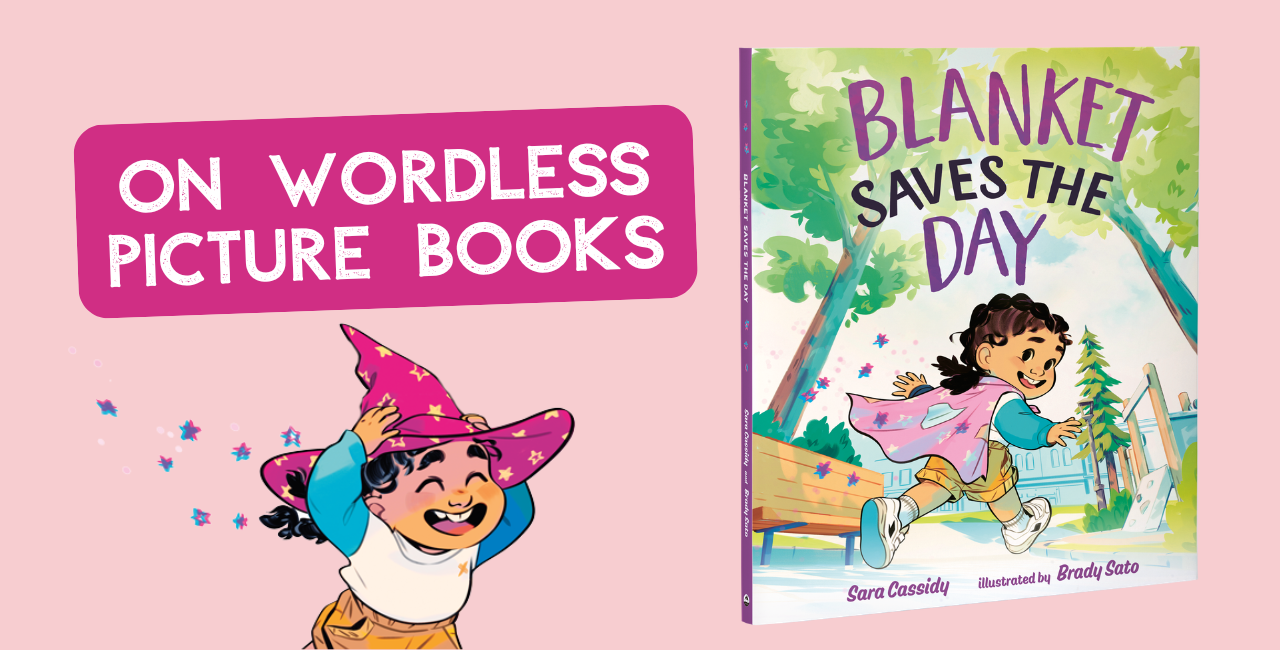
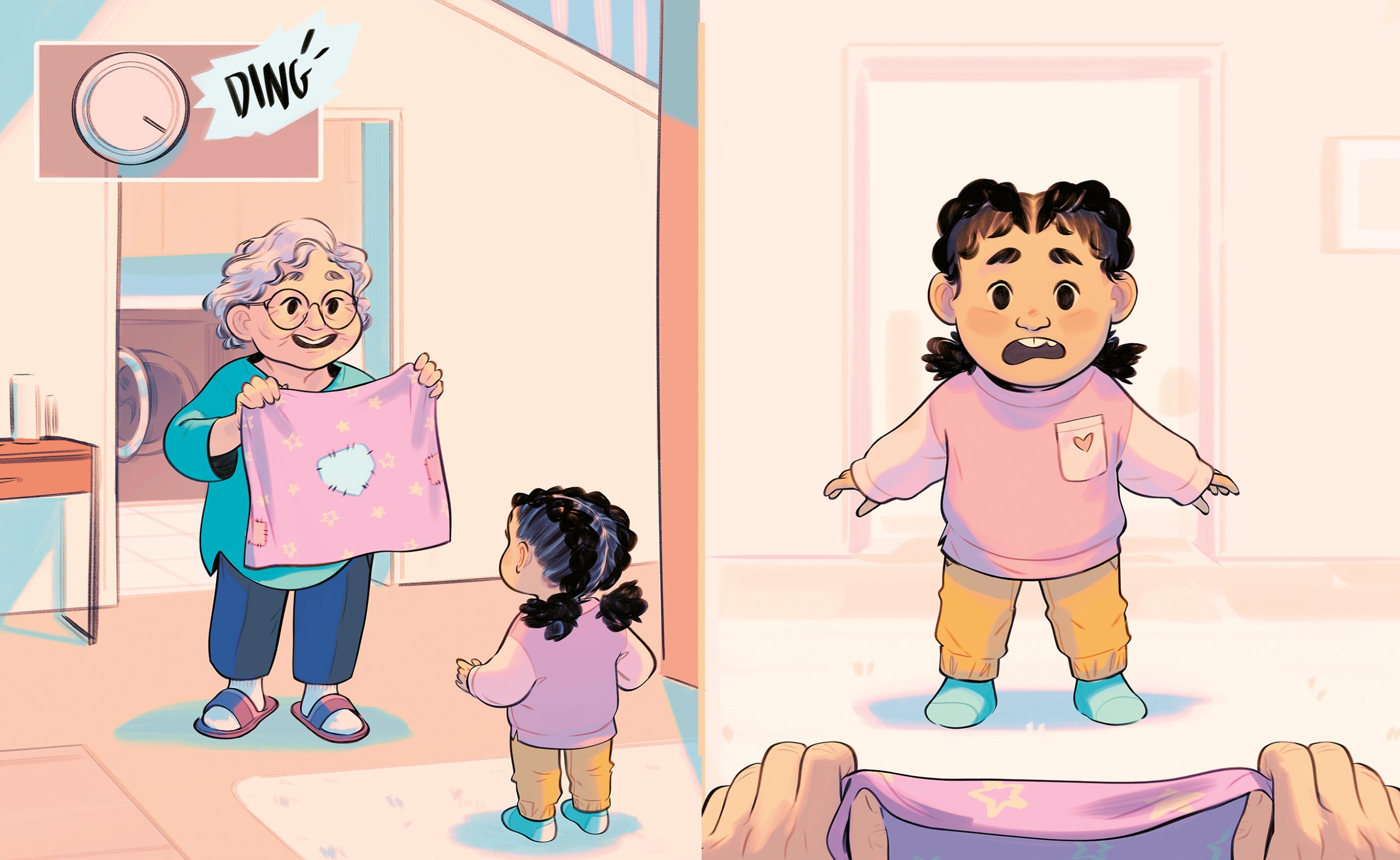
Blanket Saves the Day is Sara Cassidy’s third wordless picture book. It’s a sweet story about Josie, who never goes anywhere without her blanket…until her grandmother washes it and mends it, changing it forever. But even though Josie tries to throw it away, it comes back to help her when she needs it most. Blanket Saves the Day is beautifully illustrated by Brady Sato.
Read on to hear from Sara Cassidy about how she crafts a wordless picture book and why young readers should give them a try!
Blanket Saves the Day is your third wordless picture book! What is the process like when crafting a story without words? How is it different than writing a story with words?
It feels like writing a screenplay, since the focus is so visual. When writing a picture book with words, I cut visual descriptions such as “their house was tiny and yellow” or “she was angry,” since the illustrator can show this. During one session at my desk, I cut out so many visual cues that I realized I could “write” the entire book in pictures. I write by describing the panels for the illustrator. The biggest challenge is pacing. I am learning that a sequence of smaller pictures on one page can move the story along quickly, while a full-page illustration or two-page spread can slow things down and emphasize a meaningful or important plot point.
What inspired you to write the story?
In grade 2 we were invited to wear our Halloween costumes to school. My mother and I had spent the evening before making my costume. I wanted to be a smiley face, so we created a sandwich board with two large sheets of yellow construction paper slung over my shoulders. We’d drawn two large circles for eyes and an upturned crescent mouth. At school, my grade 2 teacher came at me with a marker, and without asking, filled in the eyes to make them more pronounced. I was upset, even ashamed (my mother’s work had been defiled!) but even at that age I knew that Mme. Bard meant well, so I said nothing. Years later, I could put into words (or pictures) this experience of unintentional violation—which change often is.
Do you have a favorite moment or illustration in Blanket Saves the Day?
I love the grandmother’s energy and how Brady captures the spacious strangeness of being at home without one’s parents. I also like the echo of Josie tolerating her grandmother’s television show with her attempt to grapple with her grandmother’s desire to wash and mend—and irremediably change—her beloved blanket.
Did you have a comfort item like Josie’s blanket when you were growing up? If you did, what did it mean to you?
Oh, yes. At one point, I had about 15 stuffed animals that I adored. Every evening, I’d sing each one a lullaby and tuck it into its personal bed. I confided in my mother one night that it was a lot! The next day, while I was at school, Mom quietly edited my collection down to a manageable number. She never told me (until years later), and I never noticed, consciously anyway. What a relief it must have been! She of course kept Mousie, a large, roundish grey mouse with a comforting sawdust scent. I often confided in Mousie—perhaps I even told them about Mme. Bard “improving” my happy face costume.
What do you hope kids take away after reading Blanket Saves the Day?
That people usually mean well. Also, that friends grow and change, and you can often rejig the relationship to make room for that. By embracing her changed blanket again, Josie also forgives her grandmother, which is a quieter offshoot.
What do you like about wordless picture books, and why should readers give them a try?
Reading a wordless picture book offers a moment of calm and quiet, and an especially deep and private relationship with the writer and illustrator—mind to mind, eye to eye. One of my wordless books was selected for IBBY’s Silent Books collection on the Italian island Lampedusa, where refugees from West Asia and Africa first touch down in Europe. Since all of the books in the Silent Books collection are wordless, any child can read them, no matter what language they speak. I love to imagine two children who speak different languages, turning a wordless book’s pages together and laughing or gasping at the same time.
Is there anything else you’d like to add?
Loving relationships with friends and family are nurtured by imagination, openness to change and a degree of perseverance—and they are well worth the effort!
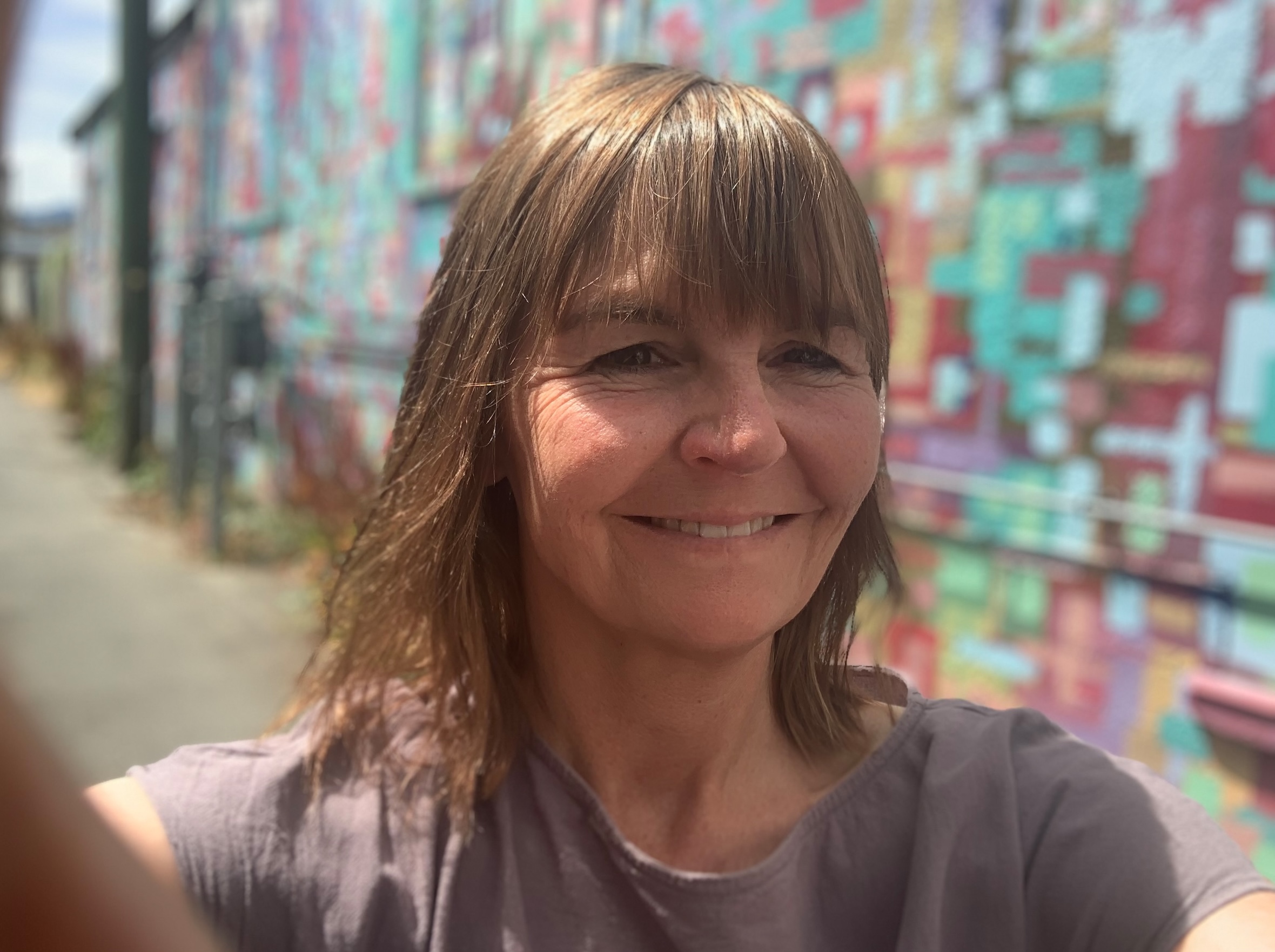
Sara Cassidy’s children’s books include finalists for the Governor General’s Literary Award in Young People’s Literature, Chocolate Lily Award, City of Victoria Children’s Book Prize, Ruth and Sylvia Schwartz Children’s Book Award and the TD Canadian Children’s Literature Award. Her early novel Genius Jolene won a BC Book Prize. Her most recent book for young readers is Star Sailor, The Story of Words. She also writes for adults. Sara lives in Victoria, British Columbia.