
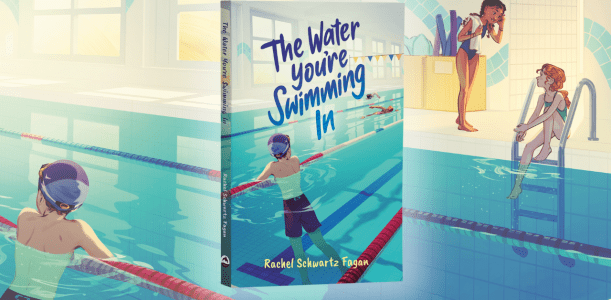
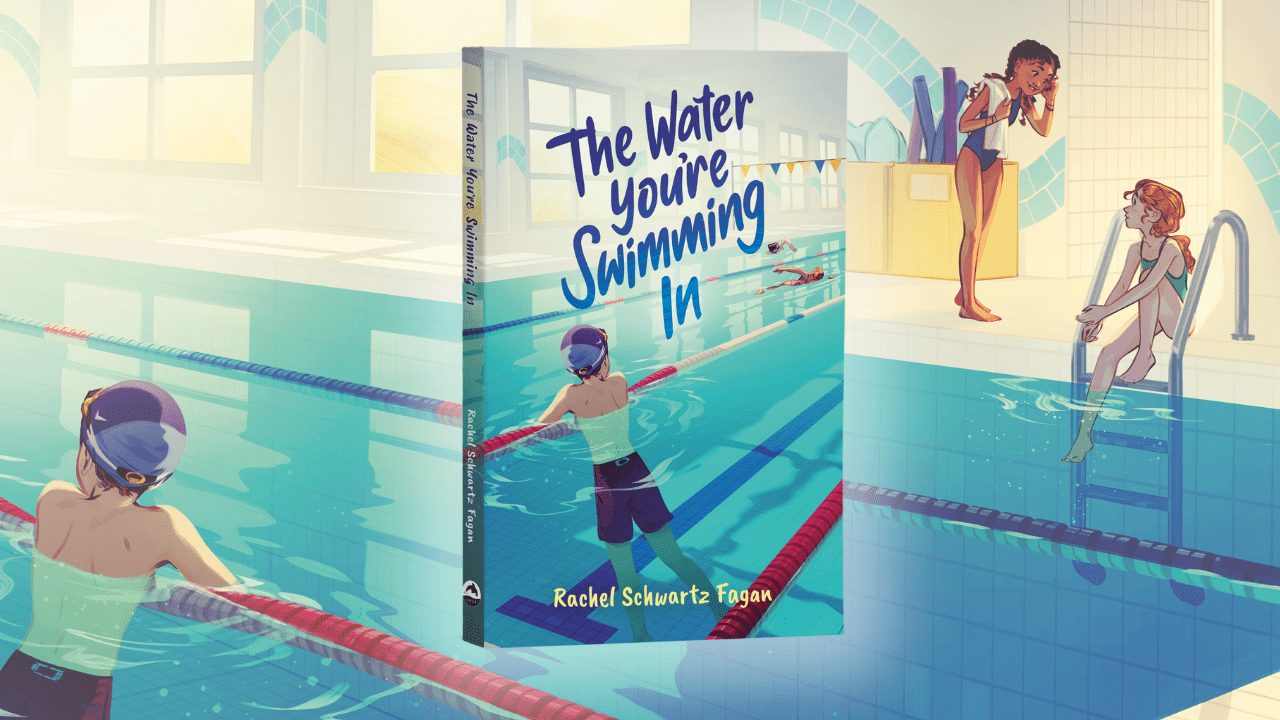
In The Water You’re Swimming In, a moving middle-grade novel, Noah tries to be the perfect kid to keep his parents happy and his anxiety at bay after his teenage brother runs away, but he finds himself floundering and sets off to find his brother himself. Read on to hear from Rachel Schwartz Fagan about her inspiration and process for writing the novel.
What inspired you to write The Water You’re Swimming In?
I got the idea for the title of The Water You’re Swimming In before I knew the story, which is something most authors would advise you not to do! I was attending an author talk, and when someone used the expression “the water you’re swimming in,” it hit me that it would be a great idea for a story. So the title came first, and then I thought about what the expression actually means. It can sometimes be hard to see “the water you’re swimming in,” meaning you can be so used to your own situation that it can be hard to see it. And that’s partially what the book is about. Noah is having a really tough time, but he’s so wrapped up in his family situation he’s not quite able to identify what’s wrong and understand how everyone else is feeling.
Why did you decide to set the story in Bible Hill, Nova Scotia?
I knew I wanted to set my book in Nova Scotia. My mom’s family is from Cape Breton, Nova Scotia, and it’s a very important place to me. Even though I’m from Toronto, I’ve been to Nova Scotia almost every year of my life. Why I chose Bible Hill specifically is that I was looking for a small-town setting that was close to Halifax and close to the water. I knew I wanted Jamie to run away to Halifax, and for a kid like Jamie, getting to Halifax from Cape Breton Island without a car would be very difficult. So I chose Bible Hill because it was close enough to Halifax that Jamie and Noah could get there by themselves—and it sits on the Salmon River, which leads out into the ocean. Plus I love the name Bible Hill!
How did you go about building the nuances for Noah’s character and his competing desires not to let anyone down and to do what’s right for himself?
I think Noah’s experience of feeling like he has to keep everything afloat all by himself is something a lot of people feel, both kids and adults. I came up with some of the aspects of Noah’s character from conversations I’ve had with friends and with my students and from my own experience as a kid with a sibling. But I have to admit, in some ways I am much more like Jamie than Noah, even though I was never quite as adventurous as Jamie is. I would be too scared to do some of the things he does, like tobogganing down the huge snowy hill!
There are lots of musical elements in The Water You’re Swimming In. Why include those, and do you play the fiddle like some of the characters in the book?
First of all, I wish I played the fiddle, but I am just a big fan. Spending summers in Nova Scotia throughout my childhood also meant hearing a lot of Celtic music. Nova Scotia has a Celtic history rooted in, primarily, Scottish immigration. Nova Scotia actually translates to New Scotland. I have so many Nova Scotia songs in my head, and I wanted to bring them to life in the book. I also lived in Ireland for a year, and I was surprised at how familiar the Celtic culture and music felt, reminding me so much of my Nova Scotia roots. To me, music is very much tied to the East Coast landscape.
Does your family have a tried-and-true chocolate cake recipe like Grandma Aisling?
Grandma Aisling’s chocolate cake is inspired by my great-aunt Ruth, who always promised that if you slept over at her place she would make you chocolate cake for breakfast. Unfortunately I don’t have her recipe, but I still remember her chocolate cake. A fun fact about my great-aunt Ruth is that she co-founded the Canadian Museum of Immigration at Pier 21 in Halifax.
What do you hope readers take away from Noah’s story?
I want readers to come to their own conclusions about the book, so I won’t say too much here. But I hope that any readers who have something big to say find the courage to say it. And I hope that we all remember the expression “the water you’re swimming in” so when we find ourselves in hard situations, we try to take a step back to see the whole picture from a different perspective. It’s something I need to remind myself to do all the time.
Is there anything else you’d like to add?
One of my inspirations for The Water You’re Swimming In is Brian Doyle’s Up to Low. It’s been one of my favorite books since I was a kid, and it’s still one of my favorites today. I thought about that book a lot while I wrote The Water You’re Swimming In. Even though the stories are very different, I thought about how Brian Doyle conveys a huge range of emotions in his book, how I feel when I read Up to Low and how I hope my readers feel when they read The Water You’re Swimming In. Even though my book can be sad at times, I wanted my readers to feel that it is also hopeful and empowering. There is a small mention of Brian Doyle’s book in the story. Can you find it?

Rachel Schwartz Fagan is a storyteller and Ontario certified teacher. She holds an MPhil in children’s literature and her work has been longlisted for CANSCAIP’s Writing for Children Competition. As a settler in Tkaronto, Rachel works in arts and education spaces and brings a passion for facilitating creativity and environmental stewardship. Rachel is an avid zinester, and her work was nominated for the Broken Pencil Zine Awards in 2018 and 2020. She is also an emerging textile artist. In her spare time, Rachel climbs on rocks, listens to the ocean and argues with her dog.